Delta Force - Scud Hunting - 1991
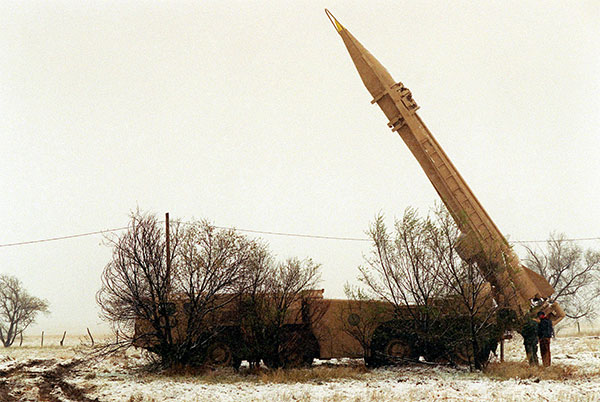
Background - during the 1991 Gulf War, in response to coalition air strikes against his forces, Saddam Hussein ordered a series of SCUD missile strikes against Israel. While of little military value, these outdated and inaccurate missiles nevertheless had a huge political impact. Unsurprisingly, Israel wanted to retaliate against Saddam. Such a move would most likely have dissolved the Arab coalition of countries aligned with the US against Saddam.
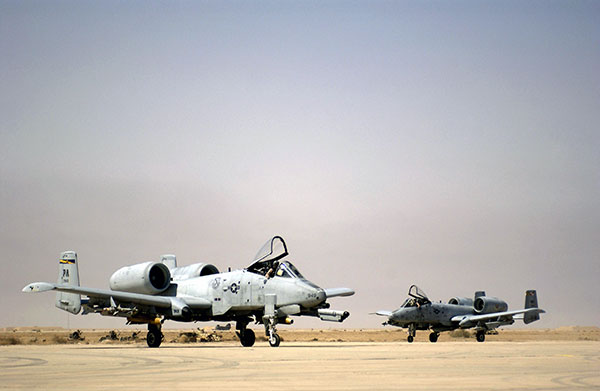
Many coalition planes were pulled off their assigned targets to go on SCUD hunting missions. The static SCUD installations had already been targeted. The problem was the mobile launchers which could operate anywhere in the vast western Iraqi desert. These were virtually impossible to find from the air.
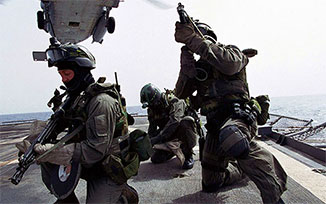
In order to placate Israel, coalition commanders decided to commit special operations forces to the SCUD hunt. The US drew from the squadron of Delta Force troops that was deployed to the region while the British looked to several Special Air Service (SAS) squadrons they had to hand. An operation was quickly drawn up for them to enter the desert and seek out the SCUDs, their launchers and associated infrastructure.
Delta Force were assigned an area of desert to the north-west of Al Qaim (SCUD boulevard) while the SAS were given the area to the south (SCUD alley).
 Al Qaim (google earth kmz file)
Delta and the SAS operated from a forward operating base set up at Al Jouf airbase in the northern Saudi desert.
Al Jouf Airbase (google earth kmz file)
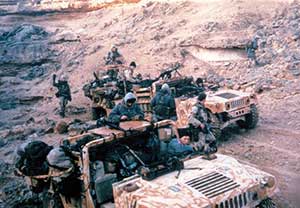
Delta Force were airlifted to and from their areas of operation by MH-60 and MH-47 helicopters from the 160th Special Operations Aviation Regiment and by AFSOC MH-53J Pavelow IIIs from the 1st Special Operations Wing., based at Al Jouf. Some Delta ground units drove in on hastily-modified HMMWVs, accompanied by Fast Attack Vehicles and motorcycles. Similarly, several SAS Land Rover columns infiltrated across the Saudi border into Iraqi.
Once inside Iraq, the teams set up covert observation posts (OP) along main supply routes (MSR). When found, the teams on the ground would call in coalition strike aircraft to bomb the targets which they would paint with hand-held laser designators.
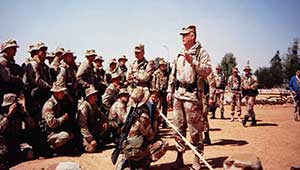
SAS units also targeted command and control infrastructure related to the SCUDs. The mobile launchers needed to contact central command in order to carry out their mission and used a network of fibre-optic cables to communicate. Whenever the SAS came across such cables, they destroyed them with explosives. They also carried out raids against communications stations, including a half-squadron assault on the 'Victor Two' communications center.
One 8-man SAS foot patrol, code named 'Bravo Two Zero
The book, Delta
When the dust had settled after the war, military analysts began to question weather any actual SCUDs had been destroyed by coalition SOF. The doubt comes from the large number of decoys that the Iraqis were believed to have deployed.